
Diastasis Recti: Why Your Core Symptoms Are Lingering
You know the feeling: that persistent lingering belly bulge or lower belly pooch, a bulge in the middle of your abdomen during core exercises (doming), or that deep sense that your abs are simply not working like they used to. Maybe you’ve tried lots of core strengthening or even pelvic floor PT only to feel frustrated that your core is still weak, it doesn’t look like it used to, or your leaking and back pain are lingering years later.
If you said yes to any of this, you may be dealing with Diastasis Recti (DR) that hasn't fully healed. The good news is, you're not broken and it still can improve. The confusion and the feeling of disconnection are real, and they start with a simple anatomical problem.
Anatomy 101: The Layers of the Core
What exactly is DR? It’s a separation in the connective tissue (linea alba) that runs down the middle of your outermost ab muscles (rectus abdominis). Every mom has some degree of DR during pregnancy, and that is totally normal!
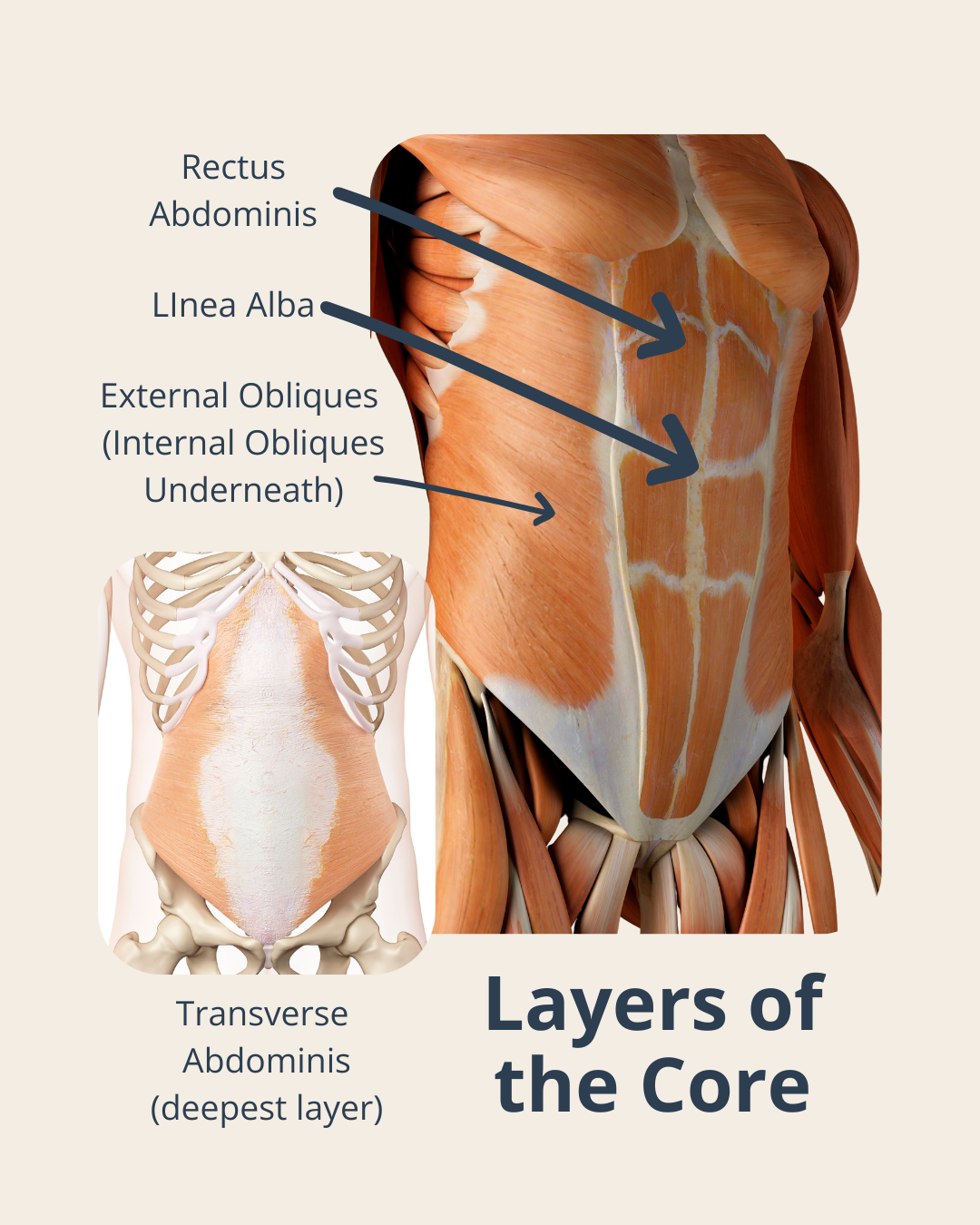
What is not normal is when that separation lingers because the tissue can't heal. To understand why this happens, you need to know the layers of your core:
- The Deep Core: Your Transverse Abdominis (TA) acts as your body's natural corset or weight belt.
- The Middle Layer/Sides: Your Internal and External Obliques are the muscles on the sides responsible for twisting and side bending.
The Top Layer: Your Rectus Abdominis (RA) is your six pack muscle and it is the layer affected by DR. The separation (the linea alba) isn't muscle, so we can't just strengthen it shut.
How to Check for Diastasis Recti at Home (Self-Screen)
Before you start any recovery work, it helps to check your own core. Remember, the depth of the separation is often more important than the width, as it tells us how well your deep core is activating. A separation is considered a DR if the width is greater than 2 finger widths and/or your fingers sink in and it feels soft and squishy.
What Makes a DR Linger?
What makes DR linger? Constant stress being forced onto that stretched-out tissue. The source of that stress is pressure.
Every time you exert yourself—whether it’s a sit-up, pullup, lift, or lifting your kids—you generate Intra-Abdominal Pressure (IAP). The core problem isn't the exercise itself, but how your muscles activate during the movement. If your deep core muscles are not activating properly, the pressure has to go somewhere, leading to:
- Outward Pressure (Worsening DR): The pressure pushes horizontally against the abdominal wall, causing the bulging, or doming, you see on your belly. This doming is visual proof that your core system is compensating and unable to manage the load. (insert photo of doming)
- Downward Pressure (Pelvic Floor Symptoms): The pressure pushes straight down onto your pelvic floor, causing leaking, heaviness, or even potential prolapse.
You can't fix a symptom without fixing the entire pressure system. My Sit-Up Reel shows you a movement that guarantees bad pressure management.
The Functional Fix: Addressing Full-Body Mechanics for Core Healing
The answer is not more core work, it’s the correct core work. It's learning how to manage that pressure and training your entire system to work together.
Phase 1: Retrain Your Breathing and Deep Core Activation
Healing your DR starts with intentional core activation and breathing:
- 360 Degree Breathwork: Start by learning how to take a good 360 breath. On the inhale, expand fully into your rib cage, abdomen, and pelvic floor.
- Zipping Up: On the exhale, contract your deep core by initiating a gentle lift of the pelvic floor and flattening your low abs. Think about “zipping up” your corset.” Don’t think too much about the lift of the pelvic floor, that should start to happen naturally without you consciously doing it.
- Read "The Base of the Foundation: Reconnecting Your Breath for True Functional Strength for more information on breathing.
Phase 2: Integrate Full-Body Stability and Movement
Healing a DR is a process that goes beyond breathing and isolated core strengthening. Muscle imbalances and mechanics at the pelvis down to the feet, or up at the rib cage, shoulders, and neck all influence core stability. This is why my approach addresses the full-body foundation—if the base is wobbly, the core will never stabilize the way it should.
When to Modify an Exercise (The Doming Rule)
The Doming Rule: Modify any exercise immediately if you feel strain or see doming on your abdomen. This visual cue is a direct sign that the exercise is too hard and your core pressure is mismanaged. Always modify to remove the strain and protect the integrity of the linea alba.
Ready to Heal Diastasis Recti and Reclaim Your Confidence?
The disconnection is fixable, but it requires intentional, specialist guidance that addresses your entire body’s posture and mechanics. Stop guessing and start building a foundation that is resilient enough for your life and your lifts!
➡️ Click below to view My 1:1 Coaching Packages and Schedule Your Consult
Not ready for 1:1 yet? Subscribe to my newsletter for exclusive tips on building a strong foundation.